


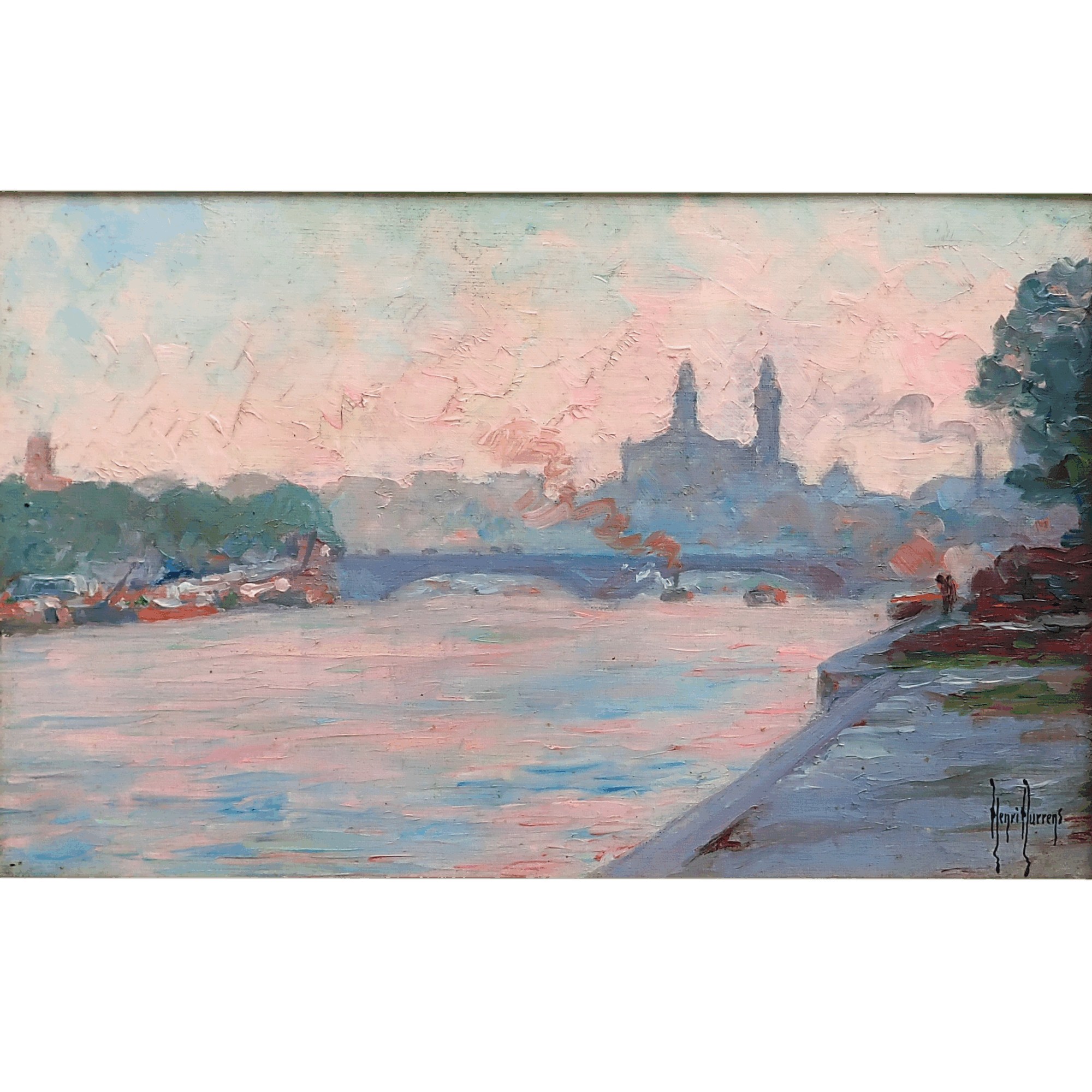


A Charming Oil on Board depiction of a French River Landscape by French Painter Louis Henri Joseph Aurrens.
Born Louis Henri Joseph Aurrens in 1873 in Marseille, he apprenticed in his hometown before moving to the capital to emancipate himself and make a living from his art.
A renowned artist during his Parisian career, he worked for several magazines of the time, caricaturing politicians.
He was also an illustrator, producing postcards and advertising projects.
He did not abandon painting, however and exhibited at the Salon d’Automne in 1919, as well as at the Salon organized by the Société des Artistes Indépendants in 1920, where he presented five paintings.
A series of drawings recently sold bore the inscription “Hri Aurrens, painter, 67 rue Lepic, Paris 18th, 1920,” placing Aurrens in the Montmartre district, an artists’ paradise.
Back in his hometown, he collaborated with several magazines, including the famous Midi Illustré. His paintings are illuminated by the warm colors of Provence, occasionally dabbling in the pointillist style.
Generous in his painting, he experimented with different techniques throughout his career.
Dedicating his entire life to his art, he died in Marseille in 1934.
A canvas signed by him and recently sold bears the inscription “Henri AURRENS 62 Rue Sainte – Marseille” and may have been his last address…
His works are featured in numerous private collections, as well as in several French museums.
A discreet artist, much of his work is still to be discovered, but he still attracts enthusiasts for the quality and rarity of these paintings.
This small format is painted in an impressionist style that depicts rather than represents this river scene.
The emphasis is on the feeling of the mood and atmosphere of the moment, not on the depiction of details.
However, it is possible to imagine the end of a summer day thanks to the tones used.
Like the green of the clumps of trees or the orange ribbon of vapor rising and diluting in the saffron mist tinting the reflections of the river.
The artist skillfully plays between primaries and complementary tones, creating a rather diffuse misty effect, or opposites, as on the banks where greens and reds stand out more.
A lovely work, calm and restful, imbued with a great deal of poetry.
Circa 1920.
Oil on cardboard, signed lower right, in a gilded wood frame.
Unframed 6 X 9 inches
Framed 8.5 X 11.5 inches