


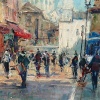
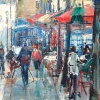

A lively Oil on Panel depiction of the famed Place du Tertre in Montmartre Paris by spanish painter Jean Salabet.
Jean Salabet is one of the pseudonyms used by the artist Juan Bayón Salado, born in 1913 in Logroño, near Bilbao, Spain.
From a modest background, he developed an early artistic talent, which he used to help his family by organizing raffles to sell his paintings and provide financial support for his family.
As his reputation grew, he was offered his first solo exhibition in Bilbao in 1941.
The success of this exhibition led to numerous other shows, and his career was launched.
In 1950, riding high on his success, he decided to travel to Paris in search of the origins of Impressionism.
His love for the atmosphere and energy of Paris was boundless.
He painted the city of that era in all its splendor, capturing every neighborhood, regardless of the weather—day, night, snow, or cold.
During this period, he exhibited in Montmartre, at the Galerie de la rue Norvins (later renamed Galerie de Bussière), and then at André Roussard’s gallery, signing his works Salabet, then Bay Sala, and finally Bayon.
From this period, he left us a remarkable testament to what Paris was like: the costumes, the bustling streets, the shopfronts, the architecture, everything is faithfully depicted, allowing us to imagine this post-war Paris where the hope for a better day made this capital the center of the world.
His international renown allowed him to exhibit alongside the greatest artists: Cocteau, Dalí, Picasso, Utrillo, Vlaminck…
He returned to Spain in 1970 and remained there until his death in 1995.
In a style reminiscent of the Cortes, Blanchard, Galien Laloue, and Jean Salabet, he brought a more romantic touch to his painting.
The street scenes seem more intimate; one has the impression that they tell a personal story, a precious memory…
The Place du Tertre is one of the legendary places in Montmartre. Located at the top of the Butte Montmartre, it is bordered to the north by Rue Norvins and offers a splendid view of Saint Peter’s Church and the Sacré-Cœur Basilica. A haven for painters, it has always been a refreshing stop, offering bistros and restaurants with inviting, shaded terraces.
Legend has it that the word “bistro,” meaning a modest café or small restaurant, originated here. During the First World War, Russian soldiers would often sneak into cafés while on duty. Fearing they would be caught by their superiors, they would impatiently call out to the café owners to be served, shouting “Bistro! Bistro!” which meant “Quickly! Quickly!”
This depiction of Place du Tertre faithfully captures the atmosphere of the place: strolling passersby, a painter at his easel, a musician with an accordion slung over his shoulder, shaded café terraces… The very spirit of Montmartre is encapsulated in this canvas.
A magnificent work by Juan Bayón Salado, from his early Parisian period when he signed his work with this pseudonym.
Original oil on canvas, signed lower left, located and dated 1954, in its original Montparnasse-style wooden frame.
Unframed 10 ½ x 14 inches
Framed 17 ½ x 21 inches