

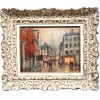


A lovely and unusual Oil on Canvas painting of the San Francesco Del Deserto Church in Venice by French painter André Hambourg.
André Hambourg was born in Paris in 1909, where he also died in 1999.
It was at school that his teachers recognized the young boy’s talent, where his drawings and watercolors were admired by all. At the time, he drew inspiration from scenes in the Luxembourg Gardens, family scenes, and still lifes.
During a language immersion trip to Germany, he bought a box of paints and created his first oil painting.
Upon returning to Paris, he enrolled at the École Nationale Supérieure des Arts Décoratifs, and then, in 1927, at the École des Beaux-Arts in Paris, studying in the studio of Lucien Simon.
At this time, his painting was often austere, with dark hues.
From 1929 onwards, he participated in numerous Parisian salons, such as the Salon des Tuileries, the Salon des Indépendants, and the Salon d’Automne.
He also held his first exhibition in a Parisian gallery.
The following year, he began to travel, discovering Brittany and then the South of France, which inspired him with its rich colors.
His palette expanded to include more vibrant hues.
In 1933, after being awarded the Villa Abd-el-Tif Prize in Hamburg, he set off to explore North Africa, where he remained until the outbreak of war. The intensity of the light and the vibrant colors definitely changed his painting style; his paintings became brighter and more dynamic.
After his military service, he joined the Resistance and later undertook illustrated reporting assignments for the Navy.
In 1945, appointed as a war correspondent, he was assigned to the 1st Army and participated in the liberation of France in Alsace and Germany, reaching the Eagle’s Nest at Berchtesgaden, where he was commissioned by the American army to depict the iconic structure.
Deeply affected by the horrors of war and the loss of several family members, art dealers, and friends, his painting lost its sources of color and light, falling back into the darkness of his early work.
He settled in Honfleur, where the ever-changing skies of Normandy allowed him to rediscover his colors and light.
With his passion rekindled, he frequently traveled between Paris and Normandy, and from the late 1950s onward, he began depicting the lively beaches of this region, such as Deauville and Trouville, painting them en plein air in all seasons.
From 1970 onward, Hambourg traveled extensively, visiting Africa, the USA, and Venice.
He painted frescoes for several buildings, including one for the European Court of Justice.
André Hambourg defies categorization, belonging to no movement or school, in his distinctive and instantly recognizable style, driven by the expressive power that animates his canvases.
Numerous group and solo exhibitions, both in France and internationally, have marked his nearly 70-year career.
Today, his works are displayed in more than 50 museums worldwide.
This work presents a lesser-known aspect of the artist’s oeuvre, despite his deep affection for Venice.
He discovered this city during his first trip in 1957 and returned tirelessly until his death in 1999, when he created his final painting there.
San Francesco del Deserto is one of the most neglected places in the lagoon.
It was for this reason that, in the 13th century, Saint Francis of Assisi, upon his return from Egypt, settled there to establish a sanctuary where he could pray and meditate in peace.
In the foreground, fishing boats are moored to stilts on which wicker baskets are drying, while a few fishermen go about their work.
In the distance, the island of San Francesco del Deserto reveals the silhouette of its red-roofed convent.
The sky, which occupies two-thirds of the canvas, is masterfully rendered, reflecting a fabulous light that illuminates and mirrors the waters of the lagoon.
A profound serenity emanates from this painting; the harmony of tones and the gentleness of the scene evoke a suspended moment, a sigh, or a reverie…
A truly beautiful and unusual work, perfectly reflecting the artist’s newfound serenity.
Oil on canvas, signed lower left, countersigned, dated 1961, and located on the reverse, in a giltwood frame.
Unframed 10 ¾ x 18 inches
Framed 19 x 26 ½ inches