


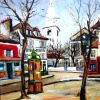


A colorful oil on panel rendition of the Place du Tertre in Montmartre, Paris by Elisée MACLET.
Born in Picardy in 1881 in the small village of Lihons, Jules Emile Elisée was the son of a laundress and a gardener, verger, and sacristan.
Thus, at the age of 10, he became a gardener’s assistant and altar boy.
After his mother’s death in 1906, the young 25-year-old Maclet decided to try his luck in Paris and settled on the Butte Montmartre.
He had a difficult start, like almost all painters of the time. He accepted every job that came his way, first at the Moulin Rouge with the “Chérettes,” then became a gardener at the Moulin de la Galette, while painting the streets and nooks and crannies of the Butte. A friend of Utrillo’s took him to the Lapin Agile, where he sold his works to the regulars. Degas gave him some advice in his studio on Rue de Clichy. Maclet began to make a name for himself, selling his paintings to local dealers.
Landscapes such as the cabarets of the Lapin Agile and the Moulin de la Galette, the Sacré-Cœur Basilica, the streets of old Paris, and views of the Seine were masterfully immortalized by Maclet, through a post-impressionist style of a certain childlike simplicity.
Considered a key figure in the evolution of the style of the painter Maurice Utrillo, a solid representative of Montmartre life in 1900, Élisée Maclet left a significant artistic mark on the Paris of the time.
As his success grew in Parisian high society, his artistic role consolidated, to the point that major Parisian gallery owners hung his works alongside those of Van Gogh and Picasso. Élisée Maclet initially developed a “primitivist” style of painting, which earned him a place among the “naive” painters of the early 20th century.
Maclet’s Parisian scenes were very popular, especially after the First World War, and this success continued past the end of his career due to the unique sensitivity and original techniques he demonstrated in his works.
Many French writers appreciated his paintings and wrote about him frequently, including Max Jacob, Sidonie Gabrielle Colette, and Francis Carco.
In 1918, one of them, Francis Carco, lent him a house he rented in Dieppe. Maclet discovered another world there; he painted the sea and Normandy, but the following year, he returned to Montmartre, where people truly appreciated his work.
In 1923, a Parisian antiques dealer introduced him to Baron Von Frey, a wealthy Austrian industrialist who took him on as a contract artist.
His patron invited him to seek a change of scenery and sent him to the South of France, Avignon, Arles, and then the Côte d’Azur, where he painted numerous landscapes, expressing his fascination with Mediterranean nature and culture.
His paintings, while in the South, took on a density and dazzling brilliance, sometimes reminiscent of Matisse.
They his joy and the happiness he felt during this period. He remained in the South until 1928.
The Baron reserved most of Maclet’s works for himself, but also sent them to wealthy collectors in the United States, going as far as donating some to numerous American and European museums.
In 1928, Maclet had his first major solo exhibition at the Barreiro Gallery in Paris, where more than 50 of his works were exhibited.
After the crash of 1929, his contract was terminated, and the financial comfort ended. Austerity was once again the daily life of artists, who had to adapt to these difficult times.
After 1935, Maclet seemed to rediscover his taste for color; he picked up his brushes again and once again walked the streets of Montmartre.
His fresh and poetic colors gave rise to pleasing canvases that regained their former popularity.
Unfortunately, the outbreak of World War II interrupted this new creative momentum, which would only restart after the war.
In 1945, the Norvins Gallery, located at 20 rue Norvins, presented his recent works.
In 1957, the first major retrospective of Maclet’s work was held at the Nicolas Poussin Gallery in Paris.
In 1960, the same gallery presented his work as part of the exhibition “20th Century Paintings”, while another major retrospective was held in 1961 at the Thibaut Gallery in New York.
In the period following his international breakthrough, Maclet was the subject of numerous magazine articles, and over time, several public collections in Europe and America acquired examples of his work, including museums in Paris, Chicago, Princeton, Bremen, Geneva, Sweden, and Norway.
After his death in 1962, Maclet received several posthumous international tributes, including solo exhibitions in Paris, Germany, and Venezuela, as well as a major exhibition at the Vestart Galleries in New York in 1969.
In 2011, the National Gallery of Bermuda organized a solo exhibition of his works. His work is currently represented in several important international collections, both public and private, and several of his paintings are held at the Musée d’Art Moderne in Paris.
Elisée Maclet’s signed paintings can be dated in time, due to the changes in his signatures over the years.
Regarding this oil painting, we are in his most prosperous and productive period after 1919. The artist was now recognized, frequenting the Montmartre cabarets, artistic and literary circles, life was beautiful…
From this joie de vivre, creations were born, more luminous and colorful than ever, which correspond to the height of the artist’s career.
Montmartre was his territory and his main source of inspiration. It is from there that everything began and always returned to.
At its center, the Basilica of the Sacred Heart, erected at the summit of the Butte, radiates its immaculate whiteness over Paris.
The Place du Tertre is located near the Basilica, separated only by the Church of Saint Pierre de Montmartre.
Maclet set up his easel on the square, making sure to capture the whole area, including the Morris Column.
A winter scene, as evidenced by the bare trees with slender trunks, deserted by any human presence, the atmosphere it exudes seems suspended in time.
The composition, however, remains perfectly balanced, between the buildings on either side and a central space that guides our eye towards the vanishing point and the bell towers of the Basilica.
The pure, vibrant colors that warm the whole, like the black lines underlining or framing, remind us of the close origins of Fauvism, born in Paris in the 1900s.
This is a very fine work by Elisée Maclet, which reflects all the sensitivity of the great artist he was.
Oil on panel, signed on the right, near the red storefront, presented in a gilded wood frame.
Unframed 18 x 24 inches
Framed 28 X 34 inches