

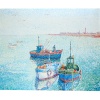
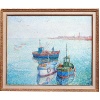


A bright Oil on Canvas painting of The Trawlers in Brittany, by French painter Yvonne Canu.
Yvonne Canu was born in 1921 in Meknes, Morocco. Her father, a Parisian architect, had married a year earlier in Casablanca.
Sent to boarding school in France, she continued her artistic studies at the prestigious École des Arts Décoratifs in Paris.
The outbreak of World War II forced her to interrupt her studies and she returned to Morocco and enlisted as a military nurse.
After the signing of the armistice, Canu settled in Montmartre, the painters’ quarter of Paris, where she completed her training at the Académie de la Grande Chaumière.
This was an opportunity for her to mingle with other artists, including Elisée Maclet and François Gall, and especially Tsuguharu Foujita, who introduced her to outdoor landscape painting.
Searching for her own style, she briefly experimented with Cubism before finally turning to Pointillism after seeing Georges Seurat’s masterpiece “A Sunday Afternoon on the Island of La Grande Jatte.”
From then on, she devoted herself exclusively to this pointillism technique, learning, implementing, and respecting its strict chromatic rules.
Canu decided to follow the path traced by another Pointillist, Paul Signac, and, like him, settled in the village of St. Tropez, which was a great source of inspiration for her colors and light.
Always seeking new subjects, she painted the French countryside, its ports, and Paris.
She achieved great success for her unparalleled Pointillist style and the modernity of her paintings, with exhibitions that continued until her death in 2008.
It was in 1886 that the general public discovered the Pointillist style of painting during Georges Seurat’s exhibition of his painting “A Sunday Afternoon on the Island of La Grande Jatte.”
Originally called Neo-Impressionism, the uniqueness of the pointillist technique, also called Divisionism, lies in the application of dots or small squares of various colors without ever mixing the colors. The artist no longer concerns himself with the mixing on the palette and leaves it to the viewer’s eye and brain to reconstruct the image.
Camille Pissarro said, “Pointillism is the art of favoring optical mixing over the mixing of pigments. And this is based on an extremely precise knowledge of colors, mixtures, and their specific characteristics.”
Fragmentation of the brushstroke.
The most famous pointillist painters are Georges Seurat, Paul Signac, Camille Pissarro, Maximilien Luce, Henri Edmond-Cross, Achille Laugé, on the men side and Lucie Cousturier, Jeanne Selmersheim-Desgrange and Yvonne Canu on the women’s side.
A little more details on the technique and characteristics of pointillism:
• A regular and orderly application of small dots of pure color across the entire surface of the canvas: the colors are thus “divided” and recomposed in the viewer’s eye;
• This division of colors gives maximum luminosity to each color, and therefore more vibrancy to the painting;
• Colors are often used in contrast with their complementary color;
• Dull or dark colors are prohibited;
• The composition is careful and considered: the shapes are simplified, but geometric lines (straight, curved, or arabesques) punctuate the composition and guide the viewer’s eye;
• The contours are not drawn, but emerge from the interaction of the dots of color;
• Traditional perspective is challenged.
In this composition with three trawlers, Yvonne Canu resolutely chose luminosity and the reflection of the elements between them.
Judiciously selected and arranged, the multitude of small, bright dots enrich the canvas background to reflect the brightness of the elements.
Thus, sky and sea interact, reflecting each other, and merging to unite on the horizon.
While the three trawlers warm the canvas with their brighter colors, their perpendicularity creates movement and dynamics in the scene.
But it is in the foreground, in the reflections of the hulls, that the pointillism technique most fully reveals its incredible ability to illuminate the canvas. The small unpainted areas between the dots of color reflect more light, magnifying the surrounding colors, creating this absolutely masterful effect of depth and transparency.
A major work by Yvonne Canu, on its original canvas, presented in a gilded wood frame.
Signed lower right, countersigned and located on the back.
Unframed 20 X 24 inches
Framed 28 X 32 inches