

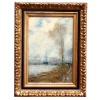


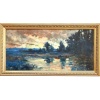



A lovely Oil on Panel rendition of a Pond by French Painter Timothée Hacquard.
Born Jules Timothée Hacquard in Besançon—in the Doubs department of eastern France—he passed away in 1918.
A landscape painter, he was born during the period when the Impressionist movement was exploding onto the scene.
However, his painting retains a certain structural quality linked to the predecessors of Impressionism—namely, the Barbizon School.
The Barbizon School—though not a formal institution in the strict sense—groups together under this name those painters who stepped out of their studios, rejected academic conventions, and ventured out to paint amidst nature…
*Plein-air* painting was born.
Working directly from their subjects, these rebellious painters could be found out in the natural world—greatly aided by the advent of the newly invented paint tube.
Another technological advancement came to the aid of these artists, who were eager for new subjects: the creation of new railway lines.
The line connecting Paris to Fontainebleau enabled these young artists to travel to the Forest of Fontainebleau and establish their headquarters in a small village bordering the woods: Barbizon.
Thus, blending two distinct styles, Hacquard constructs his landscape around a foreground in which the waters of a pond mirror the rippling reflections of the surrounding vegetation.
A bluish horizon line divides the panel into two equal halves, allowing a fiery sky to express itself in the upper section.
While the composition itself is fairly classical, its execution is far less so.
Vigorous brushstrokes make the energy of the scene burst forth; the sky rages under the violence of a wind that shakes the trees and disturbs the shimmering surface of the water.
The colors are vivid and pure, giving full vent to the fury of the elements.
The artist succeeds perfectly in conveying his ardor through this work, which combines a solid composition while flawlessly capturing the atmosphere of the scene…
A true distillation of emotion.
Oil on panel, signed lower right and dated 1897, in a Barbizon-style frame of wood and gilded, patinated stucco.
Unframed: 9 ½ x 20 inches
Framed: 16 x 26 inches