


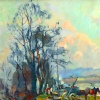


A gorgeous Oil on Canvas painting of the Cathedral of Rouen with the Seine in the Foreground by Robert Antoine PINCHON.
Robert Antoine Pinchon, was born in Rouen (Normandy) in 1886, where, raised in a literary and artistic environment, he quickly developed a passion for drawing and painting and executed his first canvas on location at the age of 12.
He enrolled in the School of Fine Arts in his hometown, but found the teaching too traditional. Accompanied by Pierre Dumont, they decided to free themselves from the academic style to devote themselves to plein-airism and travel the banks of the Seine, setting up their easels as they went.
They then joined the “free academy” created by the painter Joseph Delattre and rubbed shoulders with other talented artists, such as Narcisse Guilbert, Charles Fréchon, Georges Bradberry and a certain Camille Pissarro.
In 1902 Pinchon exhibited one of his works for the first time in a Rouen gallery.
Aged 17, he participated in his first exhibition with the Société des Beaux Arts de Rouen, where he was noticed by a knowledgeable collector, François Depaux, who took charge of the young artist’s career by buying a large part of his collection.
The exhibitions followed one after the other and the critics were complimentary of this talented artist. His work was well received and he began to make a name for himself, so much so that, in 1909, a gallery orchestrated his first solo exhibition in Paris.
That same year, 4 of his paintings were hung on the walls of the Rouen museum, following the bequest of his patron’s collection.
During the First World War he was quickly mobilized, and wounded twice, was taken prisoner during the Battle of Verdun, then escaped and returned to Rouen in 1918.
The immediate post-war period was a difficult one for artists, as there were few exhibitions and few amateurs.
But in 1922 Robert Pinchon accepted the offer of the Parisian dealer Reitlinger, planning an annual exhibition in his gallery on rue de la Boétie in exchange for priority purchase on all of his work. The Parisian exhibitions allowed Pinchon to expand his clientele and gain more critical attention, with the Herald Tribune recognizing “the vigor of his style and the richness of his palette”, Le Figaro dubbing “Robert Pinchon painter of light” and the Journal des Arts praising “his palette sings with bright and harmonious colors”…
The painter traveled abroad, selling and exhibiting in England, the United States, Norway, Hungary, Poland, Belgium, etc.
He participated for the first time in the Salon des Artistes Français in 1932, and became president of the Société des artistes Rouennais in 1935.
Despite his success, and having to stay frequently in Paris and abroad during his many exhibitions, Robert Antoine Pinchon always remained faithful to his Normandy, to the banks of the Seine and to Rouen.
He died in Boisguillaume, a town bordering Rouen in 1943.
Claude Monet said of him “A surprising touch at the service of a surprising eye”
His works are exhibited in many museums in France and abroad.
This luminous Fauve-style work, produced around 1925, is particularly representative of Robert Pinchon’s work.
The banks of the Seine in Rouen, his favorite subject, the use of bright and sharp colors placed side by side in large multidirectional flat areas, the shades often pure and applied in a thick paste, the use of colors without mixing them as they combine or oppose each other, the brushstrokes remaining visible, all this is Pinchon’s signature!
This view taken from the left bank of the Seine in Rouen from the Cours la Reine (since renamed Quai Jacques Anquetil) seen on the Pierre Corneille bridge and the Ile Lacroix, represents a snapshot of a day of activity on the quays in the first quarter of the 20th century, contrasting the time spent with the manual labor of felling trees, the cart pulled by mules with the modernity represented by the steam tugs depicted.
Pinchon pays a magnificent tribute to the daily life of these men of labor by positioning them in the foreground of his work.
The composition is bold, but masterfully executed.
The artist has treated the bottom and left part of the canvas in strong tones with sometimes bright colors, freeing up for the eye, a square in the upper right part with softer and brighter shades, which wonderfully render these misty effects of the banks of the Seine.
The sky is an example of virtuosity, the whites, yellows, blues, pinks, mauves, rub shoulders, oppose each other, overlap without ever mixing, the misty atmosphere enveloping the bell towers of the Cathedral is palpable.
Note a few details, such as the echo of the trees on the left hanging from the bell towers of the Cathedral, the use of an impressive diversity of colors to treat the foreground, the much more acidulous shades to treat the opposite bank of the Seine.
Original oil on canvas signed lower left, presented in its original giltwood frame.
Unframed 21 1/2 X 32
Framed 29 1/2 X 39 1/2