

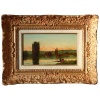


A beautiful rendition of an abandoned Church in the Snow by Victor Charreton.
Born Victor Léon Jean-Pierre Charreton in Bourgoin (Isère) in 1864, he early on, developed artistic gifts for poetry and painting.
A brilliant student, he accumulated awards and prizes of excellence. Torn between his attraction for painting and the desire to please his father, who saw him as a lawyer, he decided to pursue law studies in Grenoble.
With his diploma in hand, he acquired a position as a lawyer in Lyon in 1892. The following year he married Marie-Elmy Chatin, a woman from Auvergne.
In his free time, he perfected his pictorial training by painting the landscapes that surrounded him, Savoie, Haute Savoie, Chartreuse…
His first exhibition took place in 1894 at the Salon de la Société Lyonnaise des Beaux Arts, where he exhibited until 1933.
In 1902, following the sale of his study, the Charreton couple moved to La Sauvetat (Puy de Dôme) in the property of Elmy’s parents.
Victor Charreton then decided to devote himself to his artistic passion and, without ceasing to exhibit, he traveled to England, Corsica, Spain, Italy and even Algeria where he became a painting teacher for a while…
He continued to deepen his technical mastery, each discovery enriching his palette.
He founded, with the painter Léon Boudal, priest of the village of Murol and other artists who joined them, the Murol school.
Upon his return, he settled in Paris and exhibited at various Salons in France and abroad. He received numerous awards there.
From 1910, events followed one after the other, the French state, aware of the artist’s talent, acquired several of his paintings for national Museums.
He was decorated with the Legion of Honor for Fine Arts in 1914.
His works are exhibited in the most prestigious Art Galleries and Museums in Paris and Europe, in the USA, the Dudensing Gallery in New York, the Carnegie Institute in Pittsburgh, Camden, Portland, Chicago, Detroit, New Orleans.
In 1922, on the strength of his success, he moved into the Château de Saint Amant Tallende, overlooking the Monne Valley.
It is in the heart of this beloved Auvergne that the majority of these paintings come from, he found there, “The bluish whites of the first snows, the purple of the beech groves, the deep green of the forests, the mauve-tinged black of the volcanic stone”.
A solitary by nature, Charreton is a plein-air landscape painter, painting on the motif, even in winter, spending long hours behind his easel to transcribe his impressions.
His production of snowy landscapes certainly remains the culmination of his work, he becomes a virtuoso in this genre, working as well with a brush as with a knife to give the desired energy.
“Having never been a student of any academy, of any master… I love independence.”
In 1929, he participated in the founding of the Bourgoin-Jallieu Museum to which he donated many paintings.
Victor Charreton died in Clermont-Ferrand in 1936 at the age of 72.
His paintings can be found in the following museums:
Paris (Orsay), Bourgoin-Jallieu, Chamalières, Carcassonne, Clermont-Ferrand, Grenoble, Lyon, Murol, Riom, Toulouse…
The Brooklin Museum, Boston Museum of Fine Arts, Champaign Krannert Art Museum, Charleston Museum of Art, Cleveland, Concord, Huntington, New Orleans.
Madrid, Geneva, among others.
In this subject: An isolated church in a winter landscape, as often, Charreton knows how to capture and render the atmosphere of the moment wonderfully.
A scene where the icy atmosphere is palpable, through the large expanses of snow represented, the branches of trees stripped of their foliage, the remains of frost on the roof of the church and this winter sky, loaded with clouds announcing snow.
The artist chose an original point of view by placing his easel behind a bough of branches that animates the foreground.
For him, snow is not white, it is tinged with many shades of gray, pink, mauve…
The impasto is also very specific for this painting, as he uses knives and brushes, to create different material effects depending on the areas treated.
The graininess of the snowy part below the church is almost unique and very rarely reproduced in other works, this texture gives striking relief.
On the other hand, the treatment of the pile of boards on the left is also surprising, he deliberately left reserves without paint or scraped the color to bring out the ochre of the support, thus revealing traces of the preparatory drawing.
Victor Charreton had the particularity of producing his own colors, from judiciously selected pigments, thus creating an authenticable paste thanks to the resulting luminescence, it is in a way a radio-signature, beyond the signature itself, which he often affixed at the time of the sale of the painting…
Thus by looking at this painting under a Wood’s lamp, it is possible to discover fluorescent colors, in particular at the level of the branches which reveal a bright orange, other areas reveal greens, intense blues, mauves, in a way a whole other vision of this work.
You will note as shown on our 6th photo, the reserves of the pile of boards on the left that reveal the ochre of the support, the bright orange fluorescence of certain branches, the shades of purple, green, and intense blue revealed under Wood’s lamp.
The three poplars, barely shown on the right, give a vertical touch in a rather horizontal composition. In many of his compositions, Charreton uses poplars, a tree he prefers for its proud verticality.
An exceptional work by Victor Charreton, reproduced under n°1552 on page 457 of the second Victor Charreton Catalogue Raisonné.
Oil on cardboard, signed lower left, in a gilded wood frame.
Unframed 21 X 28
Framed 32 X 38