


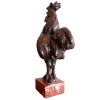


A gorgeous rendition of a Standing Rooster on a griotte marble base by Italian Animalier Sculptor Rembrandt Bugatti, in a lost-wax casting by Hébrard.
Rembrandt Bugatti was an Italian animal sculptor who, despite his short career at the age of thirty-one, left behind a prodigious body of work.
His art combined technical refinement, aesthetic forms, and intensity of expression yet his recognition is relatively recent.
Blending ambiguity between his affinities for Cubism, Futurism, and Expressionism, he assumed the role of precursor for existentialist artists like Marini and Frink. His complex psychology, his often painful life, and his innate empathy with the lives of his subjects earned him a lifelong attraction for his sculptures.
The youngest son of cabinetmaker Carlo Bugatti and brother of Ettore, founder of the famous automobile brand, Rembrandt is now considered the most important animal sculptor of the 20th century.
The artist’s first name was given to him by his godfather Giovanni Segantini, himself a painter.
Rembrandt started sculpting from a very young age and at 17, he produced his first work, Ritorno dal pascolo (The Return of the Pasture), four cows in a meadow, a souvenir of a family stay in the Engadine mountains in Maloja.
In 1903, he accompanied his father Carlo to Paris.
Carlo had decided to leave Italy, where he had triumphed at the 1902 Turin International Exhibition, and devote himself to goldsmithing in France.
In Paris, father and son met Adrien-Aurélien Hébrard, an art founder, who signed an exclusive contract for Rembrandt’s sculptures.
Hébrard used lost-wax casting in limited editions, which faithfully reproduced the delicate sculpture of Bugatti’s son as closely as possible.
The quality of Hébrard’s castings surpassed all previous and contemporary works, brining sculptures to a whole new level.
He exhibited the sculptures created in a Gallery he had opened in Paris in the rue Royale in 1904.
Rembrandt was fascinated by the wild animals he discovered at the Jardin des Plantes zoological park in Paris, where he lived next door.
Shortly after, he went to Antwerp, where the director of the zoo, known as the largest and most beautiful in the world, made a studio available to him in 1906. Rembrandt then maintained a daily relationship with elephants, felines, wolves, and vultures and birds.
Each animal was observed, and modeled freehand without any preparatory drawing.
However the First World War devastated the young Rembrandt as all the wild animals in the zoo, his friends for nearly 10 years, were slaughtered for food.
He joined the Red Cross, then the Italian army where he contracted tuberculosis and was discharged in December 1915;
During the same period following its founder’s death the Hébrard gallery closed.
Bugatti returned to Paris, no longer wanting help from his brother Ettore, who was also in difficulty, and committed suicide at the age of 31 on January 8, 1916.
He left behind a rare output synthesizing the expressionism of the Fauves and the dynamism of the Futurists.
The Hébrard gallery would close in 1937 following its founder’s death.
A gorgeous statue with a red brown patina, bearing both Buatti’s signature and Hébrard’s stamp.