
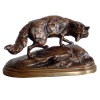


A Running Fox by French Sculptor Pierre-Jules Mêne in a model from circa 1840
Pierre-Jules Mêne is considered one of the greatest animal sculptors of the 19th century.
Trained by his father, who worked in metal, he learned the basics of sculpture and casting and decided to focus on animal sculpture.
He concentrated on depicting animals as faithfully as possible and regularly visited the zoo to observe the subjects.
He presented his works for the first time at the Paris Salon in 1838 and immediately enjoyed great success. He continued to exhibit regularly and won numerous awards.
The same year as his Salon debut, Mêne established his own foundry to produce his own models.
From 1838 to 1877, he produced excellent-quality bronzes, personally handling the casting and chasing operations.
Mêne’s work drew inspiration from both the world of domestic and wild animals.
All of his creations were enthusiastically received.
Alongside his success in France, Mêne also became famous in Great Britain, where he participated in exhibitions between 1851 and 1862.
His sculptures were particularly sought after by the English public, where a large part of his work was shipped.
He was made a Knight of the Legion of Honor in 1861.
His works are exhibited in museums around the world.
While the subject was rarely depicted by animal sculptor’s, Pierre-Jules Mêne was an exception, having created four different models.
The model presented is admirably rendered.
The animal appears trained, its nose raised to capture the slightest interesting scent, its ears pricked in alert, its right foreleg raised… everything in this model reproduces movement.
The artist has also created impressive relief for a subject of this size.
The fox’s fur is particularly full, from the mane to the densely bushy tail.
The terrace also contributes to the impression of relief; the ground is very uneven, revealing branches and pebbles.
The richly nuanced patina, in shades of brown and red, is particularly successful and contributes to the realism of the subject.
As always with Mêne, the proportions of the animal are scrupulously respected.
His early studies allowed him to reproduce animals with unparalleled accuracy.
Signed intaglio on the base.
This model is illustrated in the following books:
– “Animals in Bronze” by Christopher Payne, Page 247.
– “Pierre-Jules MÈNE – Catalogue Raisonné” by Michel Poletti & Alain Richarme, Page 173