


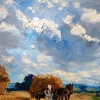


A Beautiful oil on panel of the Hay Harvest Season, by French Painter Louis Edouard Garrido.
Louis Edouard Garrido was born in 1893 in La Varenne Saint Hilaire, a charming town southwest of Paris, very popular in the late 19th and early 20th centuries for boating on the Marne River and other water sports.
He was the son of the Spanish painter Eduardo Leon Garrido, who had decided to leave Spain for Paris at the age of 19.
Having established his reputation, Eduardo Leon set up a studio in La Varenne Saint Hilaire and married one of his models, Léonie Beck, in 1892.
She gave birth to Louis Edouard in 1893.
Following in his father’s footsteps, young Louis Edouard began his artistic training with him.
By then the Impressionist movement had greatly influenced the artists of his generation, and it was quite naturally in the Post-Impressionist style that our artist chose to express himself.
Attracted by the atmosphere cherished by Monet and his peers, Louis Edouard discovered Normandy, with which he fell in love.
He settled in Saint-Vaast-la-Hougue, in the Manche department of Normandy.
A prolific painter, he painted tirelessly, depicting the Norman landscapes so dear to his heart.
He was very close to nature and the work of the peasants, whom he loved to portray in their daily efforts working the land.
He also painted the Norman coast, most often harbors with fishing boats.
There again, he emphasized the work of the sailors who went to sea at the risk of their lives to feed the population.
He was appointed director of the School of Fine Arts in Caen, then in 1934, curator of the Museum of Fine Arts in Caen.
After a lifetime dedicated to painting, teaching, and conservation, he died in Caen in 1936.
True to his values and his attachment to rural scenes, Louis Edouard transmits to us a vibrant demonstration of his talent through this superb work.
There is no doubt that we are in Normandy, the sky, heavy with gray clouds, is announcing the coming downpour, though still revealing glimpses of blue sky in between.
The countryside remains unconcerned, and the men are at work finishing the construction of the haystacks, which will preserve the fodder for the winter.
There is no respite for the farmhands.
While, dependent on the weather, they also know how to take advantage of breaks in the weather to complete their tasks.
While a farmer busies himself building a new haystack at the foot of another, the horses rest, harnessed to an imposing load of hay.
A common scene in the countryside of the early 20th century.
The foreground places us in the middle of a field flooded with the golden reflections of the freshly cut stubble; contrasting with the coldness of the tones used for the sky in the upper part.
We thus have two distinct parts that highlight the haystack and the horse-drawn cart.
Executed quickly and energetically, the brushstrokes remain very visible, and the impasto is very generous.
The artist, in this Post-Impressionist style, does not dwell on details.
Here, the important thing is to convey the atmosphere of the moment and the power that emanates from it.
Working outdoors requires very particular qualities of visualization and execution.
The speed of execution is the guarantee of a most realistic painting, faithful to the subject and the present moment.
It is the full force of the moment that is reproduced in this work, which exudes a certain serenity, opposed to the power of the elements.
A very beautiful composition, both dynamic and balanced, treated with great virtuosity.
Oil on panel, signed lower right, presented in a gilded wood frame with fluted molding, in the Napoleon III style.
Unframed 16 x 21
Framed 23 x 29