
Eugene Galien Laloue – Docked Cargo in Normandy
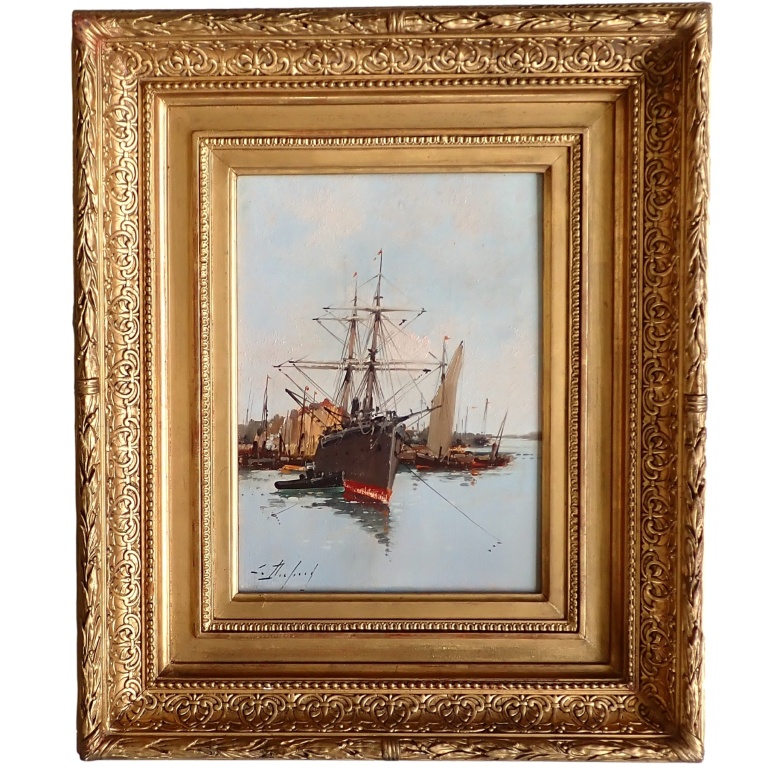
A lovely Oil on Panel picturing a Cargo docked in a Normandy harbor by Eugene Galien Laloue under his Pseudonym of L Dupuy.
Eugène Galien-Laloue (1854 Paris, 1941 Chérence), signs here under his pseudonym of L Dupuy
As noted by Noé Willer in the Catalogue Raisonné retracing Galien Laloue’s life , ‘Le Triomphe de PARIS’ :
“There are some painters who are easier than others to define, Eugène Galien Laloue is particulary difficult in this regard.
I know of no other artist who worked under so many pseudonyms.
Eugène Galien Laloue contributed to this confusion himself, covering his tracks well, perhaps because he had an exclusive contract with a major gallery?”
Willer goes on:
“After long and tedious research into various administrative and civil records, regional and national archives, museums, salons and exhibitions catalogues we can today confirm that J. Lievin, E. Galiany and L. Dupuy are all pseudonyms used by Eugène Galien Laloue.
He may have used upon occasion other names, as well.
‘There are also mysteries about his name itself. He signed “Galien” with one “L”, but there are two “L”s in many of his official papers.
Was Galien his first name or his family name? In fact, on his birth certificate in the city hall of Montmartre, Gallien (with two”L”s) is listed as his second name, though it is known that Galien Laloue’s father was Charles Laloue, a set designer.
Surprisingly, many reference books of the time list Charles Laloue as the artist’s uncle.’
When his father died, Eugène Gallien Laloue- the oldest of nine children- was only 16 years old. His mother, Endoxie, found him a job at a notary and he had to leave school.
Eugène however felt the calling of his country at the start of the Prussian war, thus leaving his job, faking his age and enlisting in the army.
By the time he had returned home from the Prussian war it seems that his vocation as a painter was already a fact.
Upon his return to civilian life, he was employed by the railroads as an illustrator. His role was to paint the railroad tracks between Paris and the provinces.
At the same time, he painted the surrounding countryside, carefully choosing the season and time of day.
Interestingly, while later he preferred painting Paris in the Fall or Winter, taking advantage of the water puddles to reflect the city lights, his Countryside painting always reflected Spring or Summer, full of warmth and tranquility….
His training appears to us as most original, more practical than theoretical, for a young artist. It seems that he learned his art in a more academic way from a certain Mr. C. Laloue, probably his uncle.
In 1876, he exhibited for the first time at the Museum of Reims, “Le Quai aux Fleurs par la Neige”.
The following year he participated in the Salon des Artistes Français where he presented two gouaches and an oil painting “En Normandie”. From 1877 until 1914, Galien Laloue was present every year at the Salon apart from 4 years between 1898 and 1903, due to the birth of his daughter.
Galien Laloue was rather reclusive, preferring to work in the solitude of his studio and rarely painted from life. His views of cities or provincial landscapes were usually based on postcards or photographs.
Galien Laloue exhibited his paintings in most French cities, Dijon, Orleans, Versailles, Roubaix, Saint Etienne, Bordeaux, or Monte Carlo.
Eugène Galien-Laloue once again delivers a magnificent view of the harbor, as he so skillfully depicted them, this time under the pseudonym L. Dupuy.
This painting offers us a new testament to the 19th-century industrial revolution.
Note the cargo ship equipped with masts for sailing, as well as two funnels for steam propulsion.
It is certainly one of the last cargo ships of this type, as it was already assisted by steam tugs that appeared in the second half of the 19th century.
In the background, the port activity is depicted by the funnel of another tugboat billowing smoke in front of a forest of masts, as is the floating sail of the fishing boat, informing us of its recent return to the dock.
Using all his dexterity to reproduce the details of the ship, masts, and ropes, the painter also carefully depicted the water and the various effects of light and reflections. The sky also receives special attention, with thicker flat tints for the clouds, creating relief directly on the panel.
The palette used is always in soft tones, with the exception of a few eye-catching touches of color.
A beautiful work in a vertical format, this oil on panel will appeal to connoisseurs of Eugène Galien-Laloue.
Unframed 8.5 x 6
Framed 14.5 x 12
Place of Origin: France • Period: 20th century c. • SKU: R-553