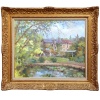


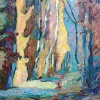
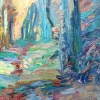
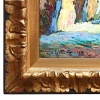

A Vivid and beautiful Oil on Panel Paiting of a ‘Sous Bois’ or Woodland Path by French painter Emmanuel de La Villéon.
Emmanuel de La Villéon was born on May 29, 1858, in Fougères, Brittany.
Hailing from an old Breton aristocratic family, Emmanuel de La Villéon dedicated his life to painting.
In 1880, he left his hometown for Paris, enrolled at the Académie Julian, and was introduced to ‘plein-air’ (outdoor) painting by his friends Alfred Roll and Emmanuel Damoye.
His work was inspired by the places where he lived or stayed; his youth in Brittany and later his time at his brother’s estate—the Château de Montmuran near Fougères—as well as Paris and, above all, the Île Fleurie in Chatou, where he sought out woodland settings and the waters of the Seine.
His marriage in 1892 gave him the opportunity to discover Switzerland, where his father-in-law owned a chalet near Yverdon-les-Bains.
That same year, he gained access to his brother-in-law’s château at Pesselières in the Cher department—an idyllic, romantic setting perfectly suited to an artist like him, featuring woodlands, magnificent trees, and water surrounding a beautiful château.
In 1900, he purchased a property at Salvar in the Nièvre department, which he kept until 1936.
These bucolic landscapes were ideal for this nature lover, offering numerous small bodies of water—elements so precious to an Impressionist in search of the sensations of nature and light.
Two-thirds of his body of work was created around four locations: Montmuran, Pesselières, Yverdon, and Salvar.
In each of these places, he pursued his tireless quest for the absolute.
Emmanuel de La Villéon loved to travel.
In 1889, his first trip abroad—to Holland—introduced him to a radiant light and ever-changing atmospheres.
In 1892, he set off to discover Spain for his honeymoon.
From 1920 onwards, he regularly stayed with each of his three daughters—in Mainz (Germany), Grenoble, and Yonville (Somme).
Emmanuel de la Villéon was one of the last representatives of Impressionism; a curious painter, he took an interest in the various techniques and experiments of other painters of the era—such as Pointillism and Divisionism, yet, being solitary by nature, he always remained independent, forging his own style through a blend of different techniques.
His brushstrokes vary; sometimes hatched, sometimes broad, and at other times tiny—creating an airy impression, particularly in woodland scenes.
Paint is often applied in pure color, sometimes mixed directly on the brush.
In the lower sections of his paintings, depicting the ground and the leaves carpeting the forest floor, his approach is bold and almost Pointillist, whereas the upper sections are more classical.
Masterful in his craft, he selects a technique for each painting based on the subject matter or the desired outcome.
His primary concern is light: how to render its shimmer on the surface of a lake or the sea, the rays piercing through forest tree trunks, or the heat radiating from a sun-baked summer plain?
To meet this vital need, he employs the Impressionist brushstroke.
These touches of pure color, rapidly juxtaposed, allow him to capture the atmosphere of a fleeting moment.
La Villéon often focused on a single view, painting it at different times of day or even in different seasons.
Snowy landscapes offered him a unique opportunity to brilliantly play with the shades of blue, pink, and violet reflected by the sun off ice crystals.
From 1890 onwards, he exhibited at the Salon des Indépendants, the Salon de la Société Nationale des Beaux-Arts, the Société Moderne, the Salon d’Automne, and the Salon des Tuileries, as well as in several Parisian galleries, including Durand-Ruel and Georges Petit.
He also exhibited in the provinces and abroad—notably in the USA in 1918, where he sold nine landscapes to American collectors, as well as in Denmark in 1925 and Japan in 1927.
In 1943, at the age of 85, he organized a major final exhibition at the Galerie La Boétie, showcasing his life’s work.
It was a success, acclaimed by critics. He decided to prepare another for the following year; however, on January 7, 1944, he was suddenly struck down by pneumonia.
He passed away two days later.
Our painting depicts a densely wooded path through the undergrowth.
La Villéon demonstrates an Impressionist touch here that is rarely seen elsewhere in his work.
The impasto is thick, clearly revealing the brushstrokes that laid down the color.
His brushwork is energetic yet confident, capturing the fleeting moment and the atmosphere of the setting with great speed, in order to fix the impression forever…
As for his palette, it displays a mastery of color theory; numerous hues sit side by side, overlap, and contrast, all without a single lapse in taste.
Depicting tree trunks in blue, yellow, or vivid, bright tones was a bold and novel choice at the time.
Yet, it is precisely this skillful blend of colors that infuses the painting with such energy and dynamism.
The work could well be classified within the ‘Fauve’ movement, even though that movement would not emerge until several years later.
A magnificent, daring work by an avant-garde, self-taught artist, a painter who worked freely, unconstrained by artistic movements or critical opinion.
Oil on panel; signed lower left, dated 1902, and numbered in ink on the reverse; presented in a gilded, patinated wood frame.
Featured on page 105 of the artist’s ‘Catalogue Raisonné’ of Watercolors, Gouaches, Pastels, and Drawings (published in 1986), in the section titled “List of oil paintings not illustrated in the ‘Catalogue Raisonné’ (1981).”
Also listed on page 247 of the artist’s ‘Catalogue Raisonné’ as #1173, titled “Allée sous-bois” (Woodland Path) and dated 1902.
23 x 13 inches unframed
30 x 19½ inches framed