






A Gorgeous Impressionist Painting of the Banks of The Seine by French Painter André Barbier
André Georges Barbier (1883-1970) was a French Impressionist painter.
Born into a prominent family in Arras, in the Pas-de-Calais region in 1883, André Barbier was initially destined to become a musician.
He began playing the piano at the age of 8 and became a virtuoso.
But very quickly, his insatiable curiosity led him to photography, then astronomy, and finally painting.
At the age of 20, he decided to settle in Paris, where his talent was quickly recognized. He exhibited that same year at the Salon des Indépendants.
Through the art critic Gustave Geoffroy, Barbier met Claude Monet, who became his friend.
Thus, the young artist found himself working alongside the Master in his studio.
His already talented hand became more supple and creative, allowing itself to be guided more by impression than by realism. The student’s paintings were deeply inspired by the Master’s advice.
His technique demonstrates his intimate understanding of the subtleties of Impressionism and his personal sensitivity to the endless interplay of light.
A landscape painter, he painted many scenes of the banks of the Seine around Paris and in Normandy.
He is also known for several canvases of the French Riviera and Italy.
Of a friendly nature, Barbier befriended many other artists, including Albert Marquet, Georges d’Espagnat, Maurice Denis, and others.
These encounters allowed him to exchange ideas on the different artistic movements of the time and to develop his style.
Thanks to his reputation, he also exhibited at the Salon d’Automne and the Salon des Tuileries throughout his career.
The famous Durand-Ruel Gallery regularly organized solo exhibitions of his works, as did other Parisian galleries.
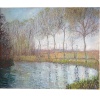
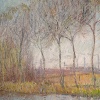
A peaceful expanse of water, bordered by a row of trees—this is a subject that fits perfectly into the Impressionist tradition, which favors outdoor scenes and landscapes changing under the effect of natural light.
A pale sky, swept by gusts of wind, slender tree trunks reflected in the water, the vegetation simply depicted with a subtlety of tones reminiscent of the Impressionist technique, where short, light brushstrokes are superimposed to create an impression of movement.
The brushwork is sometimes horizontal or vertical, in a zigzag pattern or swirling for the smoke from the chimneys, which reminds us of the industrialization of that era.
In his vision of Impressionism, Barbier maintains a more precise and structured drawing style than some of his illustrious predecessors, while retaining the spontaneity of capturing the atmosphere of the moment, thus giving his painting a unique personality.
The colors, although luminous, remain soft, in a palette of greens, blues, and browns. The reflections in the water add an almost poetic dimension, inviting the viewer to lose themselves in the nuances of the ripples.
The Impressionist context in which Barbier worked was one in which plein air painting revolutionized the way nature was represented. Artists left their studios to directly capture the effects of light and color outdoors.
The newly invented paint tubes allowed for this new freedom, and landscapes became one of the favorite subjects. Barbier, like his contemporaries, seized this opportunity to explore nature under different weather and light conditions.
His landscapes, imbued with this Impressionist approach, nevertheless retain a sensitivity that is uniquely his own: a particular attention to the structure of forms and the balance of the composition.
In short, André Barbier’s Landscape by the Water fits perfectly into the Impressionist movement while revealing a personal approach. The painting, with its subtle mastery of light and reflections, demonstrates the influence of its predecessors while asserting the artist’s unique voice. Barbier, though less well-known, reveals himself here as a faithful heir to Impressionism, while also leaving his own mark on this movement that revolutionized 19th-century art.
Oil on canvas, signed in the lower left, in a gilded Louis XV style wooden frame.
Unframed 24 x 29
Framed 32 x 37